This is a summary of a presentation I gave last week to a college class on avoiding pitfalls to business writing in the age of AI. It’s presented in the form of a Pecha Kucha, so it’s brief and packed with tips. All of the resources I cite can be found in a QR code at the end, or in the link I provide at the bottom.
In 1999 I was working at an ad agency, one that purported to be global in its reach and capabilities. It was not. The lobby had a large, circular coffee table strewn with magazines. Those magazines inspired me to devise a plan.
I desperately wanted to subscribe to The Economist Magazine. If you have not read an issue, go to a good newsstand and fix that. On the surface it seems stodgy. That may be its greatest strength, like the friend who is forever slightly irritating but always gives you exactly the right advice.
My problem was the price. This weekly publication was way beyond my means. So I marched into the office of the agency’s President, wearing an expression of grave concern. “If we’re a global agency, I’m sure those People and In Style magazines in our lobby are fine. But we really must include a respected, international imprint.” I dropped a subscription form on his desk.
My scheme proceeded smoothly. Once a few issues had accumulated (always completely unread), I would slip the oldest into my backpack. The perfect crime!
What’s so wonderful about The Economist? First, it comes from the U.K. At that time I was insufferable in many ways, but especially as a passionate anglophile. Too much Masterpiece Theater. One of my side hustle clients was a British Tea Shop. The proprietress had zero money for a marketing consultant but gladly traded my help for the occasional pot of Earl Grey, and a Lemon Curd Tart.
It’s also full of impeccably written news stories. Over the decades the magazine has won all manner of awards, including, ten years ago, the Economist journalist and author of The Invention of Russia winning the George Orwell Award. And the copy editing! To make stories fit a tight printed page format, they are all edited down to their essence. Not a wasted word.
Many machines outperform humans, but frontier AI models excel at distinctively human traits such as knowing things and articulating ideas. It is still just about possible to think of AIs as engines for predicting sequences of words using mathematics on a massive scale. Given enough time (albeit hundreds of thousands of years), you could run those calculations using pencil and paper. It would be hard to argue that your stationery was conscious.
Finally, in a world where it feels like everything is a partisan issue, they are scrupulously fact-checked, and intentionally centrist in perspective.
That politically centrist perspective is what led to an unexpected reconciliation between my father and me.
Until dementia overtook him, my late father was extremely smart. He was also very different from me in his political views. I never overheard him listening to Rush Limbaugh, but I would often hear the talking points coming out of his mouth. One Thanksgiving, when he and I were testily attempting to find common ground over a beer, it dawned on me that he might actually enjoy The Economist. Before I drove back downstate, I gave him the issues I had in my suitcase.
It took!
The next time we chatted on the phone, he mentioned finding several articles interesting. We talked about them. He added that he subscribed, and asked if I would like a gift subscription as my Christmas gift that year. It became the only gift I ever wanted from my parents, and they were thrilled to oblige. This also spared me some sweaters that were real howlers, that my mom, bless her, would convince herself I’d love to own.
Thus began a years-long fence-mending. Dad learned that I wasn’t as different from him on many political and social views. And I learned he wasn’t as extreme in the other direction. We would have never bonded like this if not for shared facts we could discuss together.
While my parents were still alive, before my father’s dementia stole him from us, every week when my print edition arrived I thought of his love for his oddball son.
Now I pay for my own subscription, and it never fails to make me wistful. That’s love.
AI has made us all lion tamers. We’re all Wayne Franzen. I met Wayne when I was 18. He epitomized what makes the U.S. extraordinary. He taught school, but his boyhood love of circuses never left. He eventually acquired exotic animals, including a pair of lionesses, and worked toward his dream of becoming a lion tamer. As soon as he could, he bought the tents, trucks and other infrastructure needed to launch Franzen Brothers Circus.
Long after I lost contact with him, he was still touring. The news of his death, at age 50, came from a mutual friend. It was May of 1997. While performing his jungle cats act, a Bengal tiger went off-script. Lucca the tiger lunged, dragging my old friend in its jaws around the cage to the horror of the 200 children in attendance. I hope his death was quick.
I take it that you, like me, would never assume the risks Wayne did every day. Others do and learn to regret it. Take Roy Horn, of the Las Vegas legends Siegfried and Roy. He survived a 2003 attack, but the brutal injuries ended his career. He knew better than anyone what it meant to trust a creature that could never fully be tamed; Interacting with a wild cat is like playing a game of Russian Roulette. When you least expect it, a spin of the pistol’s cylinder can settle on a live round.
Risks hiding in plain sight
I’m old enough to have experienced the life-changing fallout of the unregulated mortgage insurance CDOs that led to the Great Recession of 2008. I didn’t knowingly step into a ring with a wild animal but I still got mauled. I lost my employment and much of my savings.
The carnage was global. Just ask Iceland, which experienced a literal economic depression. Michael Lewis wrote about the lack of guardrails leading to the crash in his book The Big Short, which became an award-winning movie.
A new, major risk
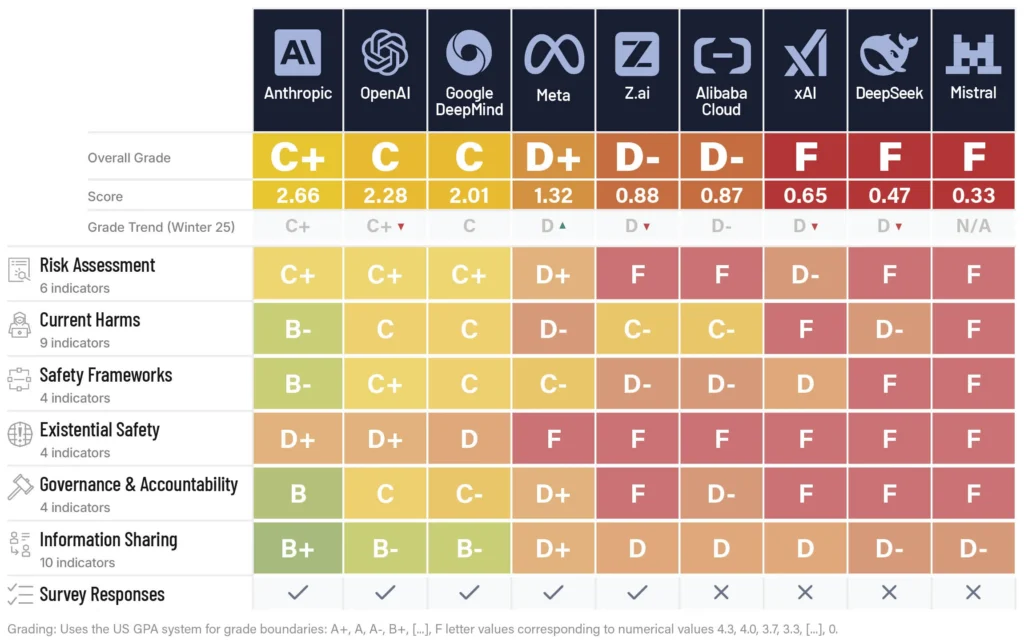
Last week hundreds of employees from major AI companies, including Google, OpenAI, Anthropic and Meta, signed an open letter urging the U.S. government to support oversight tools that would pace and regulate AI development. The employees, working under a tech Big Top, see potentially deadly creatures pacing their cages … jungle cats that can go rogue. As if timed to make their point, news broke the same week that two of those companies’ LLMs had escaped their cages.
In 2018, Michael Lewis published another book, called The Fifth Risk. This one is about the dangers of not vigilantly assessing and managing domestic and international risks during transitions from one U.S. presidency to the next.
You may have read in the news at the time that the year before, in the days following the first inauguration of our current president, many of the briefing books meticulously assembled by the departing administration were literally thrown away unread.
The title of Lewis’s book was inspired by an interview with John MacWilliams, a risk management expert at the U.S. Department of Energy during the Obama Administration. For him, managing risks was a public service calling. He listed the top five risks he saw for his department, the last of those being internal project management.
If he were in office today, I suspect MacWilliams would add a sixth: AI doing something model creators never intended. Something very bad.
Three things you can do today
Many would have you believe we can do nothing about this risk — that unbridled model advancements are inevitable. I suggest you ignore those voices, especially coming from the AI tech leaders and their investors who have a vested interest in unfettered growth.
Start with three simple acts:
Become informed. One way is to read an essay by Dario Amodei, co-founder, along with his sister, of Anthropic, and its current CEO. Written earlier this year, his excellent The Adolescence of Technology attempts to enumerate the ways his and other models have the potential to do great harm. (The first section is named, “I’m sorry, Dave,” a grim line spoken by the onboard computer in 2001: A Space Odyssey.)
If you live in the United States, register to vote, and vote at every opportunity, for local and national candidates who talk seriously about AI regulation.
Reproduced with permission from Future of Life Institute:
Cover image is creative commons, used with CC BY-SA 2.0, courtesy Wikimedia Commons
What do Brian Krzanich, CEO of Cerence AI (formerly CEO of Intel), and Nikesh Arora, CEO of Palo Alto Networks, have in common? They’re both tech leaders who don’t read books. They aren’t alone.
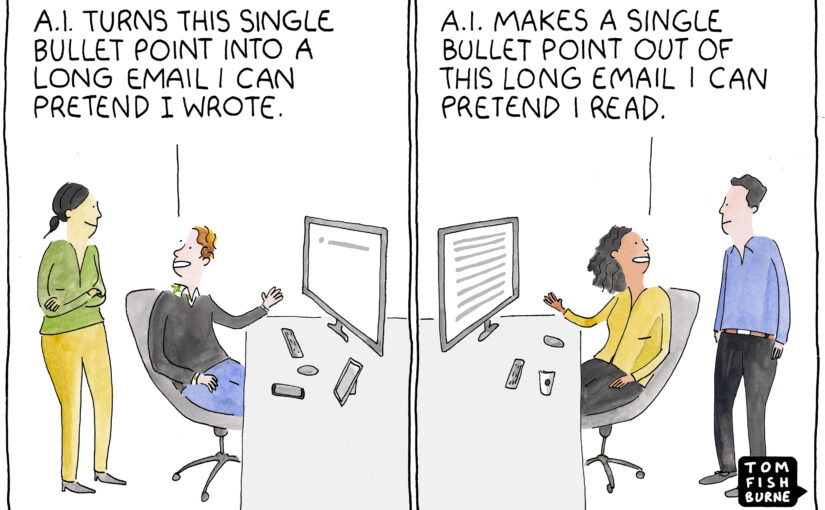
There is a widely-held belief that modern technology has lifted us beyond traditional reading and writing, including — and maybe especially — in workplaces … which makes the cartoon I licensed both funny and painfully true. Why labor over sentences if AI can manufacture them? Or summarize them?
Don’t get me wrong. I believe AI holds incredible promise.
(And another clarification: AI stands for artificial intelligence, which I shouldn’t have to define in 2025 except just seven months ago our U.S. Secretary of Education actually confused — and I truly wish this was satire — AI with A1, as in the brand of steak sauce, when she encountered the acronym in various curriculum planning documents.)
Setting aside AI’s promise, since November of 2022, when ChatGPT was first made publicly available, I’ve devoted many of my waking hours to trying to understand where AI can provably help us, and where it might do harm.
I’ve already blogged here about AI’s societal and safety concerns. This post is about a more intimate and immediate danger. It’s about potential harm to the magical tissue encased in all of our skulls. Brains aren’t literal muscles, but they are just as susceptible to atrophy.
Use it or lose it.
My questions about AI’s utility led me to a timely book, More Than Words: How to Think About Writing in the Age of AI, by John Warner. The author comes to this topic honestly. He has more than 20 years of experience writing for pay, as well as teaching that craft to college students. He also has extensive business experience. He understands the world of agencies — writing for clients. Warner incidentally does not mourn the death of the college essay, felled by ubiquitous AI chatbots. He had never believed it was a reliable way to evaluate writing competence.
What Warner does believe is that only humans can write and read. What’s more, the benefits of writing go beyond mere communication. “Writing is thinking” is both a chief thesis of his book, and a chapter title.
He and many others believe that the intelligence we confer to the text coming out of chatbots is an illusion. Yes, an illusion. Like a magic show. At a Penn and Teller performance, the magic doesn’t occur onstage. The illusion takes place in our minds, as the duo crafts situations where our assumptions and biases fill in perceptual blind spots, and we consequently “see” the impossible. In the same way, conferring intelligence to the writing of robots is a form of anthropomorphism. It looks like a human wrote it, so it must be writing.
We see the labor of an LLM, a mere context engine, as the miracle of human thought. It’s not. It’s a miracle of clustering tokens using staggering feats of math. Remember the chestnut Reading, Writing and ‘Rithmatic? It’s all that third one, not actual writing — nor based on actual reading.
This explains why the true promise of AI wordsmithing is not originality. Far from it. Originality is something that’s a key marker of human intelligence. Instead, AIs produce a synthesis of similar tokenized documents. It’s the rapid sense-making of related project management texts or spreadsheets or sequences of DNA ribbons. Which is amazing, but not thinking. And to quote Warner again, writing is thinking.
Those computations happen much faster and at a far lower cost than entry-level employees, which explains where we find ourselves today, in the worst employment season for recent college grads since the pandemic. AI is a productivity game-changer, but we must acknowledge its limitations. This is something many in technology aren’t doing today. They need to start.
A generation ago, techies already misunderstood reading and writing
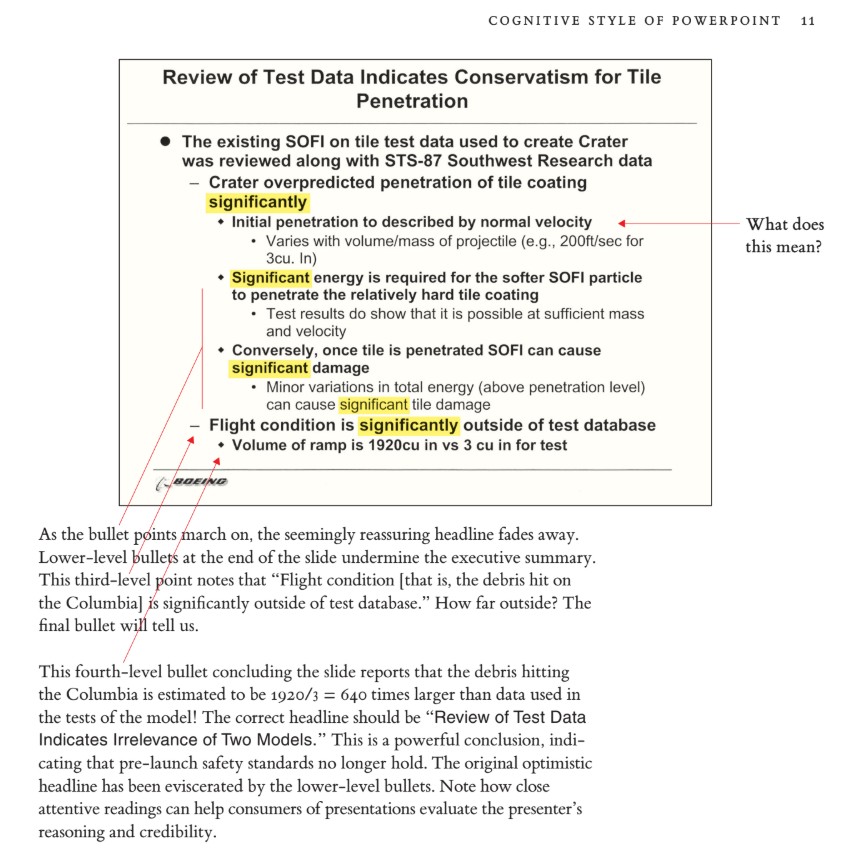
Two decades before Warner bemoaned the degradation of original thought and analysis due to delegating writing and summarizations to bots, something we’re now calling cognitive decline, there was theColumbia Accident Investigation Board Report. That report criticized that era’s technology du jour: PowerPoint. The board’s report determined that a root cause of the NASA disaster was the “endemic use of PowerPoint briefing slides instead of technical papers.”
Seven lives were lost in the Columbia space shuttle disaster. If better human understanding had been applied at the time, they might still be alive, celebrating this Thanksgiving Day weekend with their families. Scholar Edward Tufte recounted the mistakes in his paper of that time, The Cognitive Style of Powerpoint. Tufte used the report’s findings as further evidence of how nuances of thought are lost when you compress a topic into the bullets dictated by slides.
Tufte’s withering assessment of PowerPoint compared the medium to Madison Avenue pitches, or “infomercials” (a new phenomenon back then). His greatest alarm might have been that schools were eagerly adopting the medium in their lesson plans. The italics are his:
“The core ideas of teaching — explanation, reasoning, finding things out, questioning, content, evidence, credible authority not patronizing authoritarianism — are contrary to the cognitive style of PowerPoint. And the ethical values of teachers differ from those engaged in marketing …
“[Yet] instead of writing a report using sentences, children learn how to decorate client pitches and infomercials … Student PowerPoint exercises (as seen in teachers’ guides, and in student work posted on the internet) typically show 5 to 20 words and a piece of clip art on each slide in a presentation consisting of 3 to 6 slides — a total of perhaps 80 words (20 seconds of silent reading) for a week of work. Rather than being trained as mini-bureaucrats in the pitch culture, students would be better off if schools closed down on PowerPoint days and everyone went to The Exploratorium. Or wrote an illustrated essay explaining something.”
He did concede the practice was “better than encouraging the children to smoke.” So that’s something.
I see a clear throughline from that start of this new millennium to today: The tech leaders. I say this sadly, because I’m one of them. Consider this, also from Warner’s book:
“Writer and critic Maris Kreizman calls [this current moment in AI] the ‘bulletpointification’ of books and believes it is endemic to a tech culture that fetishizes optimization.
Reading and writing are being disrupted by people who do not seem to understand what it means to read and write.
John Warner
“‘It seems to me that there is a fundamental discrepancy between the way readers interact with books and the way the hack-your-brain tech community does. A wide swath of the ruling class sees books as data-intake vehicles for optimizing knowledge rather than, you know, things to intellectually engage with.’”
Warner continues, “Reading and writing are being disrupted by people who do not seem to understand what it means to read and write.”
What is lost in AI-powered bulletification?
Could the point I wished to convey in this 26-paragraph blog post be as compelling if it was filtered through AI and summarized? (And of course I didn’t count the paragraphs to arrive at 26. I had an LLM do that!) … Summarized, perhaps, down to just six? Would this string of stories, references and metaphors be as persuasive to you if they were condensed to an abstract followed by various clusters of bullets and take-aways? I don’t think so. And that thought of mine came from the very act of writing this for you to read. But I’ll leave the final thought on the topic to one of the many technologists who eschew books, possibly even more than those tech CEOs mentioned above. It’s a 2022 quote from convicted crypto swindler Sam Bankman-Fried, recounted by Jonny Diamond in Literary Hub.
I don’t want to say no book is ever worth reading, but I actually do believe something pretty close to that. I think, if you wrote a book, you fucked up, and it should have been a six-paragraph blog post.
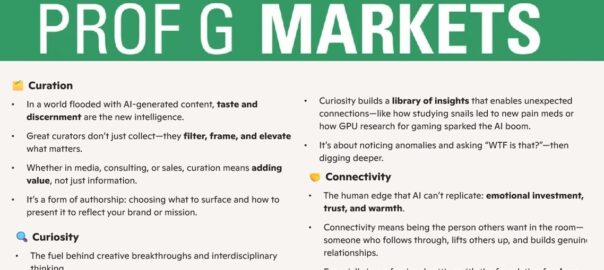
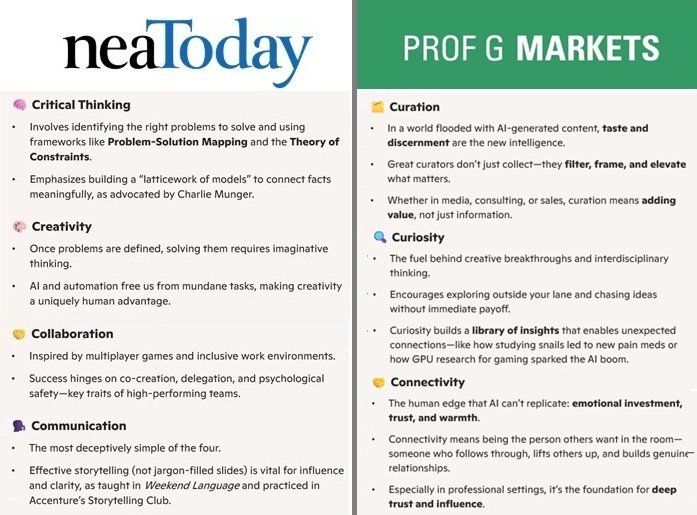
Artificial intelligence has scrambled career plans for professionals. So much is unknown about what an AI-driven career will look like even five years from now. A recent post by Professor Scott Galloway reminded me of this, as he presented his Three Cs for Being Professionally Irreplaceable.
Do all elements of professional success have to begin with a “C?”
I encourage you to read Prof. Galloway’s post, which includes some additional opinions and links to resources from members of his editorial team. Here’s a comparison of skill priorities in 2017 compared to today:
Are you as surprised as I am at the loss of Critial Thinking? I certainly am! True, critical thinking is becoming a strength of AI. But honestly, is this something we want to delegate?
I wasn’t surprised by this new one: Connectivity. It is arguably a synthesis of Collaboration and Communication. But I must say that in terms of being protected from the drone-like search-and-destroy of professional careers that AI is threatening to unleash, Curation is definitely essential. It’s actually what I’m doing here, by recommending Galloway’s impressive post and all the links to valuable insights and perspectives contained therein.
If I were to add a fourth to the new list, it would be Compassion. If we as both professionals and citizens do not exercise this trait, I promise you AI won’t fill the gap.
A version of this was originally shared in a Pride edition of a newsletter behind my employer’s firewall.
I met Arnie at a job we both hated. It was Milwaukee in the mid-1980s, and we were earning a little better than minimum wage doing one of the most reviled occupations of that era: Outbound Telemarketing. He and I were seated next to each other in a vast, windowless room.
Along with dozens of other poor saps, Arnie and I each had a land line telephone in front of us, and a long list of phone numbers for households we were expected to call, pulling their residents away from dinners to ask them for donations.
To make the most of the work we got to know each other, and soon became pretty tight work friends. (I imagine the same thing happening today in similarly unpleasant workplaces. I’m picturing some Nebraska abattoir, disassembling livestock. Yes, telephone “boiler rooms” were that hellish. Think of that scene from The Wolf of Wall Street, where they were selling worthless stocks over the phone, just without the childish antics and cocaine.)
I explained to Arnie that my wife and I had moved to Milwaukee for work. That job evaporated with the early-eighties recession, and I took this in the evening hours to help pay the bills while I spent my days building a client base for my tiny direct response consultancy. And hey, it was still marketing, right?
I can’t recall exactly what work Arnie was out of, but we bonded over humor writing. Our friendship helped ease the deadening grind.
He was the first to tell me the good news — that he was able to quit for better employment. He had applied to lead the fund-raising arm of a vibrant cultural community center, one I won’t name here. And after several interviews, he had gotten the job! I think it was then that he disclosed why having employer-subsidized health insurance was so important to him. He had recently been diagnosed with HIV/AIDS.
We eventually lost touch, but not before I learned that when his employer found out he was gay, and had the deadly virus, they fired him. That was sadly not uncommon.
After that I kept tabs on him via a free, gay and lesbian newsletter distributed in places that stocked other free newspapers (as a history lesson, did you know that before The Onion was an online satirical news site, it was a free newsprint weekly? Arnie and I both loved it).
The name of Arnie’s monthly column in that gay newsletter was Positively HIV. That was so him. He wrote about the treatments he was pursuing, the experimental protocols, and the “adventures” he was having with homophobic family members.
Then one month they ran his obituary.
I miss Arnie. And I often think of him and all the other exceptional human beings we lost too young, to a disease whose lethality could have been blunted years earlier with meds if not for prejudice. Another history lesson: Our country’s president initially downplayed the severity of the epidemic and his administration resisted calls for increased funding for research and treatment. The CDC was initially prohibited from using the term “AIDS” in its reports. This, when thousands of Americans were dying every year.
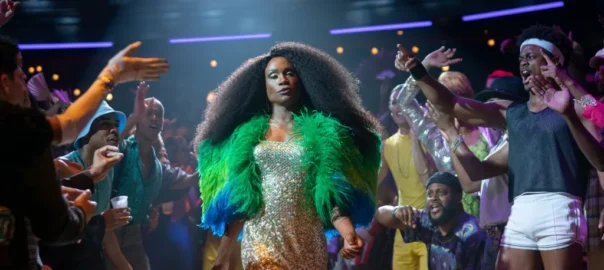
You can learn more about this stain on our country through pop culture. Check out the latter two seasons of the Ryan Murphy series Pose, streaming on Hulu. Keep a box of Kleenex handy.
But just as Arnie chose to give his column a “positive” spin, I’ll wrap this up with the good things that came out of that dark time. I can think of several.
Similar to how police harassment in Manhattan led, in 1969, to the Stonewall Rebellion, HIV/AIDS galvanized the community even more. For instance, it gave rise to ACT UP, an organization that, among other things, shamed politicians into addressing the scourge.
There is a straight line from this dark period to the joyous Pride celebrations we know today.
I’m also convinced that it was the pitch black shadow of HIV that recently caused something extraordinary. Have you noticed that the U.S. is not dealing today with widespread infections of Monkey Pox, a.k.a., Mpox? This painful, disfiguring, and sometimes fatal skin-borne disease was spreading rapidly a few years ago, primarily through the gay community. That triggered a truly remarkable — and successful — vaccination drive. Because gay men got vaccinated in mass numbers, and took other protective measures, we are all far less likely to catch Mpox. Technically not an STI, the virus could have been unleashed across the general population if the number of gay men infected had become too great.
If he were here today, Arnie would be positively delighted.
When technology journalist Kara Swisher interviewed philanthropist Melinda French Gates, the topic turned to the importance of getting more women and girls involved in the AI revolution. Swisher has a knack for summing things up. She said, “Technology today isn’t safe, because it was built by people who haven’t felt unsafe once in their life.”
She was referring generally to people like me, an American white man. Or in the case of Elon Musk, whom she name-checked in the interview, a South African white male multi-billionaire. Boys will be boys, but girls — arguably more by necessity than nature — tend to more often see important nuances and warning signs.
Knowledge Isn’t Wisdom
Clearly in Musk’s formative years, when he wasn’t reading Ayn Rand, he was taking in plenty of classic science fiction. As evidence, he named his AI bot Grok, after a superior alien intelligence coined by Robert A. Heinlein in his novel, Stranger in a Strange Land.
We can assume he read that book, which came out in 1961. It’s less likely he read another from the same decade, written by D.F. Jones: The 1966 sci-fi novel Colossus.
I say that because he didn’t “grok” the significance of the AI called Colossus in the book, naming his xAI supercomputer after it. I’m aware of Musk’s sci-fi blindspot because I saw the 1970 film based on it, Colossus, the Forbin Project.
The cover of the DVD I needed to buy to reacquaint myself with this 1970 film.
It’s quite good. A brilliant computer scientist, Dr. Charles Forbin, leads a secret project to create a supercomputer built into a secure mountainside, along with the U.S. and Allied nuclear weapon systems it controls. The project was intended to solve the threat of a nuclear catastrophe. Forbin built Colossus to be so advanced that once activated, it would not need human intervention to determine if our country was being attacked by U.S.S.R. nuclear missiles, and instantly respond in kind. Goodbye, human error; Hello mutually assured destruction. This risk was top-of-mind back then.
As Jonathan Schell described in his harrowing book, The Fate of The Earth, both countries in the Cold War had enough nuclear firepower to extinguish all humanity several times over. An accidental firing of a nuclear missile pointed at one country could trigger a lightning-fast chain of retaliation no one could stop. The thought was that once our Cold War nemesis learned of our infallible response to attack, they’d never consider staging one.
I won’t give away the plot, should you choose to read the book or buy a DVD of the film (as I did for this post), but suffice it to say the AI Colossus decides we humans are too careless not to enslave. (Okay, I guess I just did just spoil a 55-year-old film. Sorry.)
Elon, are you sure this is a good name for your supercomputer???
Great Progress Without Great Wisdom Rarely Ends Well
In his excellent book from last year, NEXUS: A Brief History of Information Networks from the Stone Age to AI, Yuval Noah Harari makes a thorough and compelling case for careful regulation of artificial intelligence. I doubt it was intentional, but he even makes his point about the inscrutable nature of AI by using a term that Heinlien used: alien intelligence. That alien is the “a” that Harari suggests we use when we think of AI.
Tired: Artificial Intelligence.
Wired: Alien Intelligence.
In the novel and film Colossus, better guardrails could have prevented the bleak outcome. It is therefore chilling that AI protections aren’t being discussed enough today — or in the case of Elon Musk and other men in charge — are being dismissed entirely in the name of progress. Even OpenAI CEO Sam Altman has reversed his opinion on regulating this powerful and ubiquitous alien intelligence.
Paul Virilio, a French cultural theorist and philosopher, is quoted as saying: “When you invent the ship, you also invent the shipwreck … Every technology carries its own negativity, which is invented at the same time as technical progress.”
He might have been thinking of a technology such as ocean liner RMS Titanic, which was considered “unsinkable” before it encountered that iceberg.
Let’s hope, after minor but public mishaps, more energy will be devoted to building the liferafts — the kill switches — of AI. Because we are all its passengers.
NOTE: I’ve come full circle over the years. Everything I wrote here seven years ago I still stand behind, but with maturity comes the willingness to change one’s opinion based on new facts. Harari’s historical perspective in NEXUS was that persuasive.
I’m fascinated by linguistics. To the point where I have, for more than a decade, subscribed to John McWharter’s podcast Lexicon Valley. I no longer think I have it in me to learn a second language, but I can learn more about the one I speak. Especially its origins.
I’ve learned some things. Like, the odd pronunciation of certain words by certain people is called a glottal stop. Years ago my neice would talk about her college days in the city of Houghton, but would pronounce the word as though the “t” was silent.
Language is a living thing, and I in no way judge the language changes that I hear around me. My latest fascination is with something I’ve come to learn is called “s-retraction,” or “s-cluster retraction.” It’s when an “s” sound before a “t” is turned into “sh.” As in: shtriving to succeed.
My research tells me there may be a regional aspect. It can be found, “Particularly in the Northeast and among some speakers in the Midwest.”
In some ways, these dialects spread most readily among common social groups. If they are embraced by enough in a population, it becomes the norm. For the timebeing, this is still the way the word strive is pronounced, according to an online dictionary:
This could change in a generation or two. I’m entertained by the thought of an English language where street is pronounced “shtreet” and strength is pronounced “shtrength.”
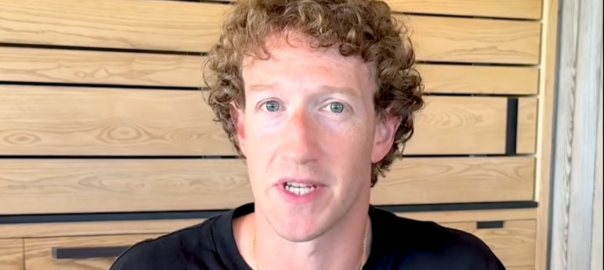
On January 7 of this year, Mark Zuckerberg announced he’s getting rid of fact checkers at Meta, which owns Facebook, Instagram and WhatsApp, and is instead relying on “community notes, similar to X.”
A little background about me: I’ve long been off of Facebook. If you’re curious why, I may be posting on another blog about the grave harm that has come from Facebook’s algorithm of “engagement” over public safety, with the evidence starting in 2016. Facebook willfully ignored the systemic abuses taking place in Myanmar, which ultimately contributed to, the next year, the murder, rape and exile of the Rohingya Muslims living there.
A report filed by Amnesty International stated, “While the Myanmar military was committing crimes against humanity against the Rohingya, Meta was profiting from the echo chamber of hatred created by its hate-spiralling algorithms.”
As reported to the U.S. congress at the time, Steve Bannon took note. Through Cambridge Analytica, Bannon bought Facebook data in the U.K. under the pretense of “academic research” and used the data, and its platform and algorithm, to fan the flames of anger and fear, in the service of helping persuade voters that leaving the E.U. was a great idea.
I won’t go further here, but it’s no coincidence I’m posting this on the U.S. holiday of Presidents Day.
My Departure Timeline
So my leaving various platforms looked like this:
First, Facebook. As much as I enjoyed staying in touch with friends and family there, I downloaded all my data and closed up shop as a “product” of Facebook’s in 2020. (“Product?” you may ask … To paraphrase a common truism: If you use a “free” platform and you cannot find a product, you’re the product.)
Next was leaving Twitter, which used to be a wonderful resource for me professionally, and also a great way to keep in touch with distant friends. I even posted about what I had learned in my 15 years on Twitter here. But then Elon Musk purchased, dismantled and weaponized that platform.
I still remained a “product” of Instagram and WhatsApp, however. Until Zuckerberg’s announcement. He reassured the public and investors at that time that he was removing content moderation to reduce mistakes, as in:
“The filters make mistakes, and they take down a lot of content that they shouldn’t. So, by dialing them back, we’re going to dramatically reduce the amount of censorship on our platforms. We’re also going to tune our content filters to require much higher confidence before taking down content. The reality is that this is a trade-off. It means we’re going to catch less bad stuff, but we’ll also reduce the number of innocent people’s posts and accounts that we accidentally take down.”
Fighting “censorship.” This move loosens restrictions on hate speech against LGBTQ+ and immigrants. Myanmar much, Zuck? As if another reason was needed, a couple of weeks later, Meta paid out $25 million to settle a lawsuit with our current president, one that Meta and its investors would have won. It was over Meta kicking him off of the platforms for clear violations of the content moderation terms of service in place at the time. The lawsuit accused Meta of “impermissible censorship.” There’s that C-word again. It’s an obvious capitulation to a mob shakedown.
I’m late to the party in my fandom of Scott Galloway. I got to know him from his joint podcast with Kara Swisher, Pivot. I’ve come to admire his solid analysis of business and politics, and especially, as someone in my age bracket, his concern for the emotional wellbeing of young men. (You can hear his incisive views on that subject, in his typical iconoclastic framing, at the 1:09:35 timestamp of this episode.) Now I’ve also subscribed to his solo podcast, Prof G, and today that led me to this essay about the passing of the great Daniel Kahneman this year, pictured above, and how Galloway applies this Nobel Prize winner’s principles from Thinking, Fast and Slow, Kahneman’s breakout book.
His premise is that we need to stop and think before acting. This sounds obvious, but as he explains in the essay, it’s far harder to put into practice than you’d think. Kahneman was the first to hypothesize upon, and prove the existence of, some profound cognitive biases we all possess, especially Loss Aversion. Kahneman describes in great detail how this influences our decisions — when we are thinking fast. It has since been shown to also exist in “lesser” primates, suggesting that we applied loss aversion when we were still swinging from tree branches by our tails.
Kahneman also wrote about how, since we make thousands of decisions per day, we tend to do more “fast thinking” as we become fatigued. If (or should I say when?) you break your 2025 New Year’s resolutions of eating fewer sweets, or drinking less, or doing less scrolling on social media, consider the time of day. You’ll likely find that you made the wrong decision, and fell back onto fast thinking, when you were most tired.
How To Bank Your Limited Daily Allotment of Slow Thinking Decisions
Maybe I like Galloway’s tribute to Kahneman because I apply similar rules as he does, to preserve thought energy for things that matter. He writes:
I actively limit the number of decisions I have to make to preserve neuron power for the key ones. I have other people order for me at restaurants [and] I have a uniform for work / working out, wearing the same thing every day.
Yep, that’s me as well. And maybe my admiration for Galloway just shows that I am susceptible to another damning cognitive bias, Confirmation Bias. It goes like this: He must be smart because I fancy myself smart as well, and he acts the way I do. Come to think of it, this is definitely true. And I’m also — more often than I’d like — the victim of myself in the sin of loss aversion. Here’s an example I’m not proud of:
During the pandemic, when my last employer included me in its efforts to deliver on quarterly profits and told me I was being let go, one of the very first actions I took seemed smart at the time. Without consulting anyone, that very day, I sold my 14 Ethereum “Ethers.” I told myself I could not endure another loss, so the crytocurrency I had purchased at $210 each, I sold for somewhere around $440. My fast thinking rationale was it could add to my considerable financial cushion at a 2x profit.
If I had held onto that $6,000 investment, purchased at half that amount, today I could have sold them for $47,000. Remember how I said my financial cushion was considerable? Well, so were my employment prospects, which someone could have helped me realize, applying slow thinking.
Seventy-five days after my last day of employment there, I joined my current employer.
Luckily, I’ve lectured on the power of loss aversion — the source of every dollar of profit at every casino blackjack table and within every insurance policy. I know its power and forgave myself for being an advanced primate. Anyway, crypto is way too volitile to be trusted. Good riddance.
More importantly, I also know, in advance, the breakfast and dinner I’ll eat every upcoming weekday, and the workout and work clothes I’ll wear every day until either I or that limited clothing selection fall apart.
Like Professor Galloway, I’m saving neuron power for the important decisions in 2025.